



Exporting in times of uncertainty: geopolitical risk map for Spanish companies
Wars, tariffs, maritime blockades and restrictions on raw materials. The global landscape has become more complex, but companies that understand risk are best placed to turn it into opportunity.
March 4, 2026
Risk map: five open fronts
| Front | Level | Key impact |
|---|---|---|
| Front
Iran–US/Israel War
|
Level
CRITICAL
|
Key impact
Brent > $116. Gas Europe +30%. Threat to the Strait of Hormuz (20% of world oil).
|
| Front
Global trade war |
Level
CRITICAL
|
Key impact
Trump threatens to cut off trade with Spain. Tariffs 15% global. Exports to the US States -8%.
|
| Front
Ukraine-Russia War (4 years)
|
Level
HIGH
|
Key impact
Russian gas to EU reduced by 2/3. EU defense spending: €381 billion (+62% vs 2020).
|
| Front
Red Sea and Suez Crisis
|
Level
HIGH
|
Key impact
Suez traffic -45%. Deviation +14 days. Port surcharges in Spain: €142M.
|
| Front
Rare earths restrictions
|
Level
MEDIUM
|
Key impact
China restricts 12/17 rare earth elements. Semi-conductors impact, defense, VE.
|
| Front
Panama Canal
|
Level
MEDIUM
|
Key impact
Droughts. Water surcharges. Maximum capacity but low volumes.
|
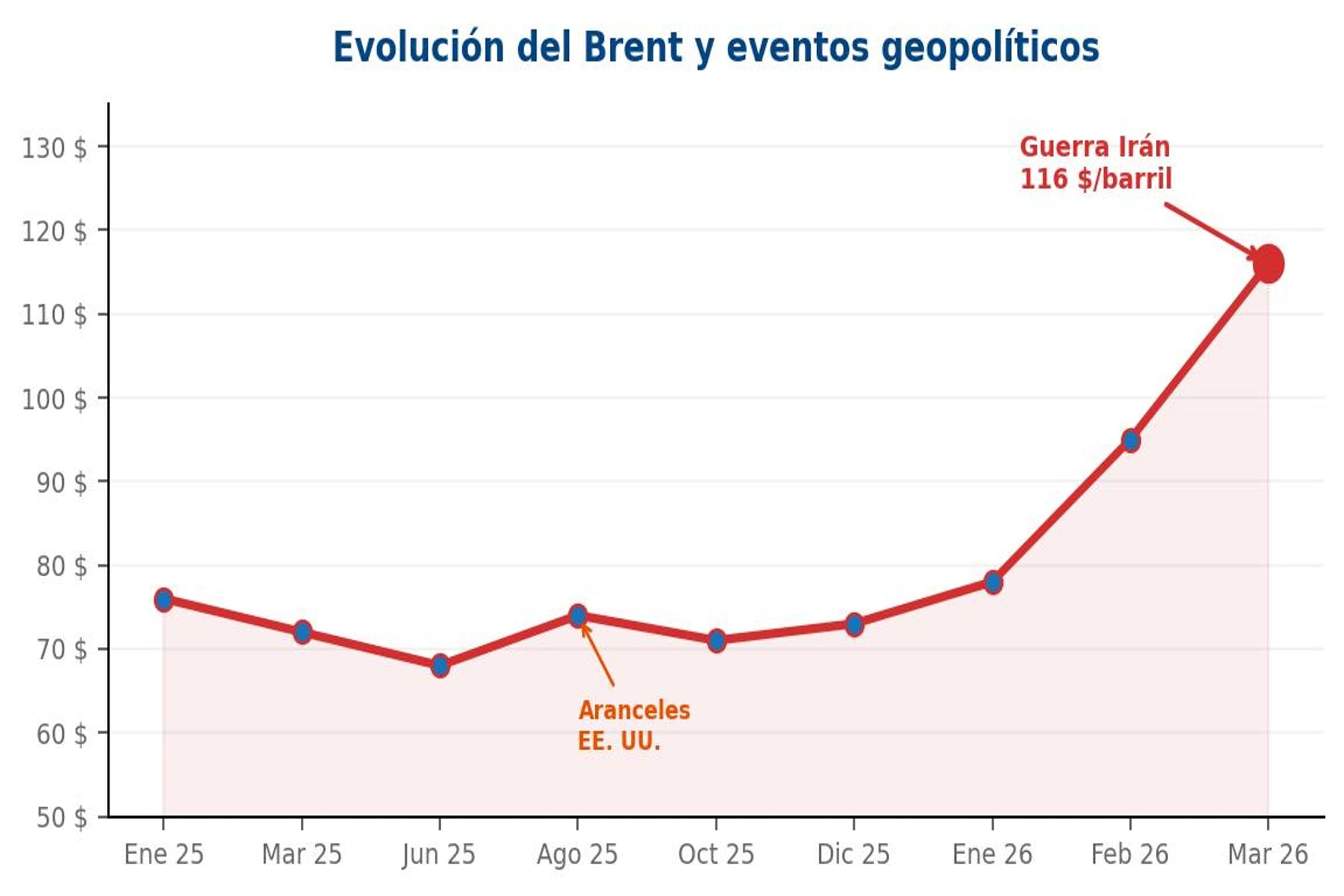
Brent crude oil price evolution and geopolitical events
Energy and logistics: the double strangulation
The conflict with Iran has jeopardized the Strait of Hormuz, through which 20% of the world's oil passes. Brent crude rose above $116 and European gas soared 30%, exceeding €70/MWh. For Spanish companies, this translates into higher production, transport and electricity costs.
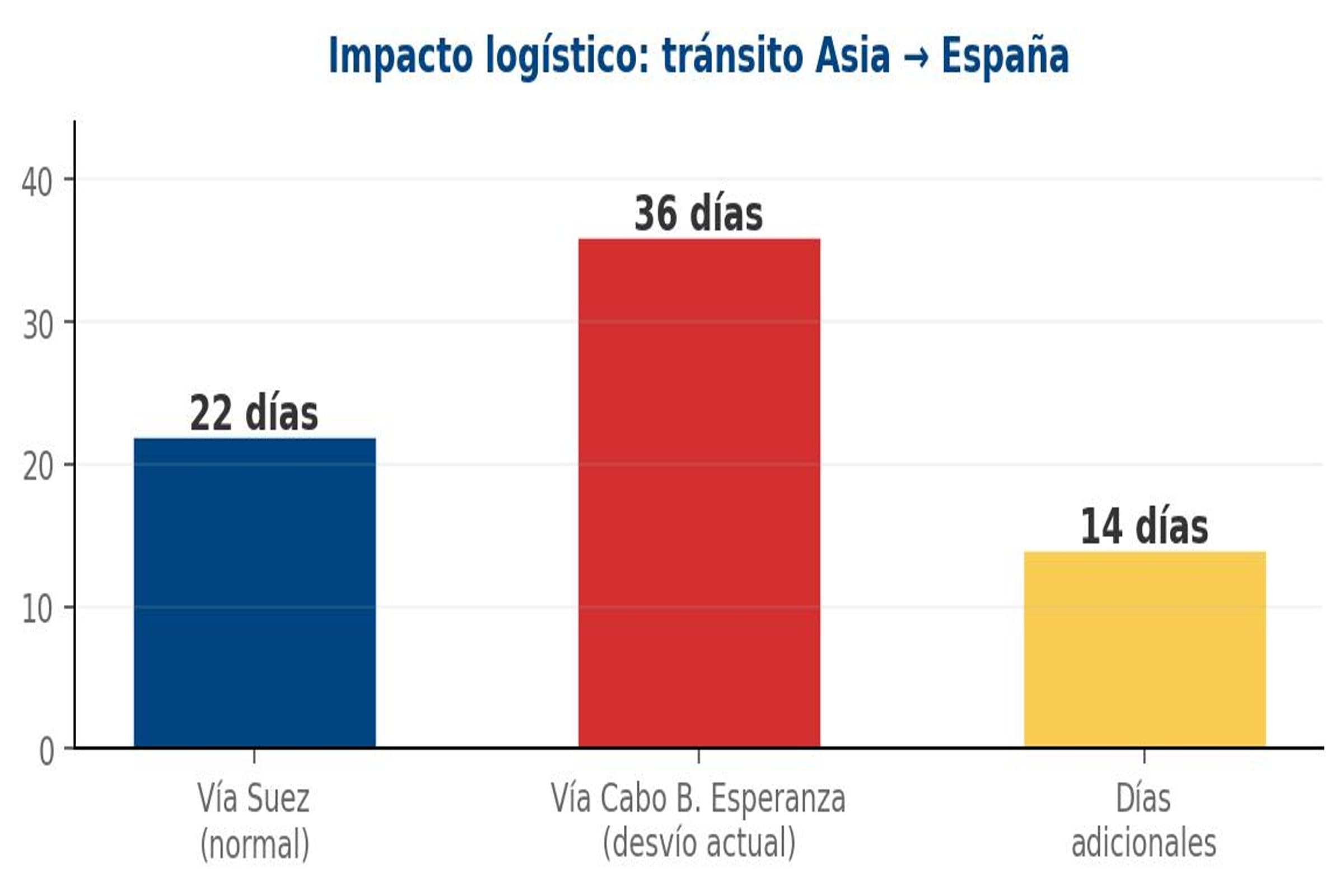
Meanwhile, the Red Sea crisis has resulted in 45% less traffic through the Suez Canal. Ships are being diverted around the Cape of Good Hope, adding 14 days to transit and an estimated additional cost of 142 million euros for Spanish ports in 2026.
Logistical impact
Tariffs and trade war: the new wall
| Tariff front | Measurement | Impact Spain |
|---|---|---|
| Tariff front
The United States → EU
|
Measurement
15% global (Sec. 122) + Sectorial Sec. 232.
|
Impact Spain
Exports to the US States -8% Oil, wine, ceramics, steel.
|
| Tariff front
The United States → China
|
Measurement
Tariffs > 100% on some products.
|
Impact Spain
China redirects surpluses to Europe: unfair competition.
|
| Tariff front
China → EU/US States
|
Measurement
Restriction on 12 rare earths + semiconductor control
|
Impact Spain
Automotive, electronics and renewables ES at risk.
|
| Tariff front
EU → China
|
Measurement
Tariffs on Chinese EVs (up to 45%).
|
Impact Spain
Temporary protection of the European automotive sector.
|
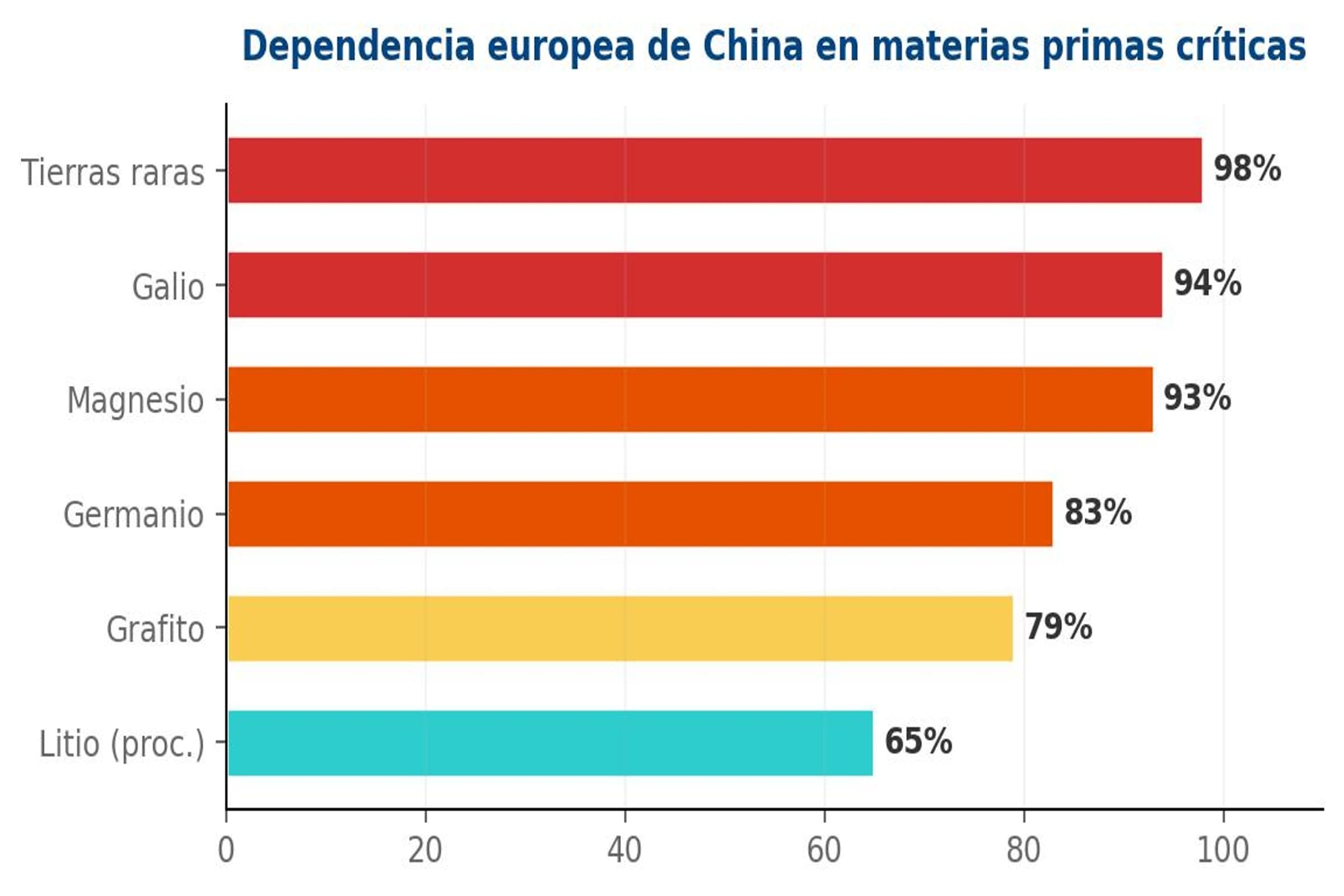
Strategic raw materials: the new geopolitical weapon
European dependence on China for critical raw materials
Six tips for Spanish exporters
1. Diversify markets and suppliers
Do not depend on a single destination or a single source of supply. The EU-Mercosur agreement and African markets are real alternatives.
2. Financial coverage
Use instruments for hedging currencies, interest rates, and commodities. Export credit insurance is essential.
3. Nearshoring and friendshoring
Consider relocating part of your supply chain to allied or nearby countries. Morocco, Türkiye, and Eastern Europe are viable options.
4. Digitize your supply chain
Real-time visibility tools, predictive planning, and AI enable you to anticipate disruptions and react in time.
5. Monitor geopolitical risk
Integrate country risk analysis into your business strategy. What happens in Hormuz or in the US Congress States affects your profit and loss statement.
6. Seek out specialist advise
Tariff, health, and customs regulations change every week. A regulatory error can cost more than the tariff itself.
Uncertainty cannot be eliminated. But it can be managed
Companies that integrate geopolitical risk into their export strategy not only survive — they find opportunities where others see barriers.
International Analysis Team — Oftex
Internationalization Consultant · BBVA Partner · oftex.es
Sources: WTO · UNCTAD · KPMG Trade Outlook 2026 · Funcas · CNN · Euronews · Xeneta · Maersk Insights · European Commission · Ministry of Economy