



Don’t export where you can; export where they’ll buy
August 20, 2026,Reading time: 4 min
SUMMARY:
Choosing the destination country determines the outcome of any export operation, and yet it's often decided based on gut instinct. Analyzing each market based on five factors—product demand, competition, regulatory barriers, logistics costs, and payment risk—helps avoid failed investments in markets with limited potential. A data-driven methodology based on official sources that turns the intention to sell abroad into real business opportunities.
POST:
Choosing the wrong market is the costliest mistake in international expansion. We’ll show you how to get it right with a method—not intuition—and why the “obvious” country is almost never the best one.
Spain closed 2025 with €387.092 billion in merchandise exports, its second-highest figure on record, with 46,230 companies exporting regularly (10.4% more than five years ago). The message is clear: Going international is now within reach of any SME with a good product. But there’s one key factor that determines the outcome: it’s not enough to want to export; you have to export to the right country.
And this is where most companies stumble. The costliest mistake in international expansion isn’t logistical or tax-related: it’s choosing the wrong market. Because when the country isn’t a good fit, everything else—your product, sales efforts, and investment—is wasted.
The first mistake: choosing a country based on intuition
The same scenario plays out again and again: A company decides to sell abroad and targets the United States or Germany “because they’re big markets,” or responds to the first email from a supposed importer that happens to land in its inbox. Neither is a strategy; they’re hunches.
The problem is that choosing the wrong country can be extremely costly. It means adapting the product, obtaining certifications, traveling to trade shows, translating catalogs, and sometimes signing with a distributor that never sells anything. Months and thousands of dollars spent only to discover that there was no room for your product in that market, or that you couldn’t compete on price. A big market isn’t your market.
What really determines whether a country is your market
Choosing systematically means running your product through five filters before spending a single dollar on travel:
- Actual demand for the product. Is there demand for what you sell, and does it fit local habits—not just is the country large or wealthy?
- Competition and pricing. Is there an opening? Can you compete without being the cheapest? A saturated market or one dominated by very inexpensive local products is rarely worth pursuing.
- Barriers to entry. Tariffs, mandatory certifications, technical regulations, labeling, and packaging language. What is a formality in one country can be a wall in another.
- Logistics and payment. Distance and shipping costs, lead times, and—critically—the country’s risk of nonpayment. Selling far away and not getting paid is the worst kind of business.
- Cultural fit and sales channels. How products are actually sold there: distributor, agent, direct sales, or marketplace. The right channel depends on the country, not on what you’re used to.
Why the “obvious” country is almost never the best one
Where does Spain export? Export destinations (2025)
The 2025 data confirms it. 62% of Spanish exports still go to the European Union: a natural market, yes, but also a concentration of risk. Meanwhile, sales to the United States fell 8% amid the tariff war, while destinations many had written off grew: Africa by 6% and Asia by 3%. The hot destination was cooling off while emerging markets were picking up the slack.
62% of Spanish exports are concentrated in the EU: convenience, but also risk. · Source: ICEX / Secretary of State for Trade, year-end 2025.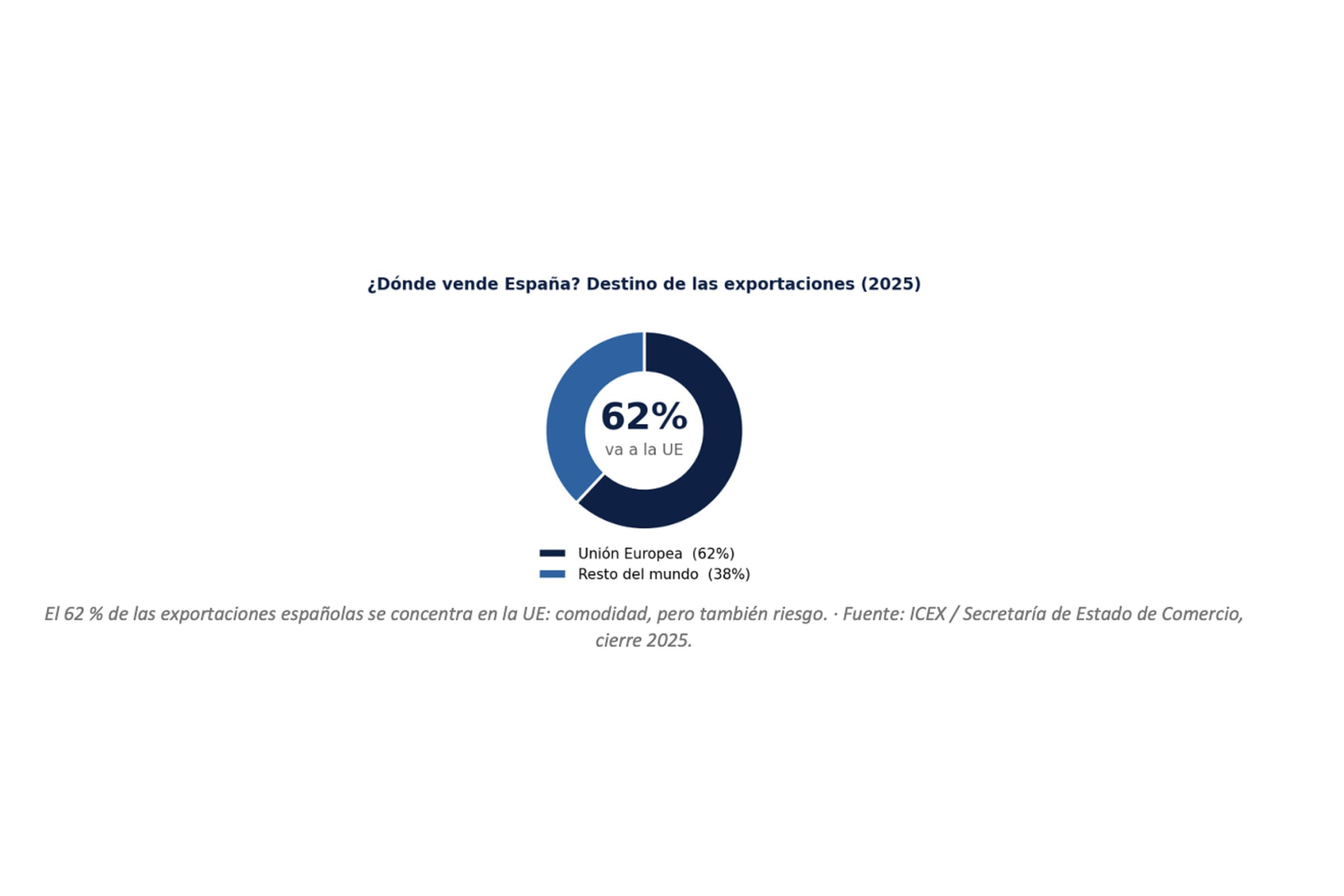
Change in exports by destination (2025)
While the U.S. States While the U.S. fell 8% due to tariffs, while Africa and Asia grew.
Source: ICEX / Secretary of State for Trade, year-end 2025.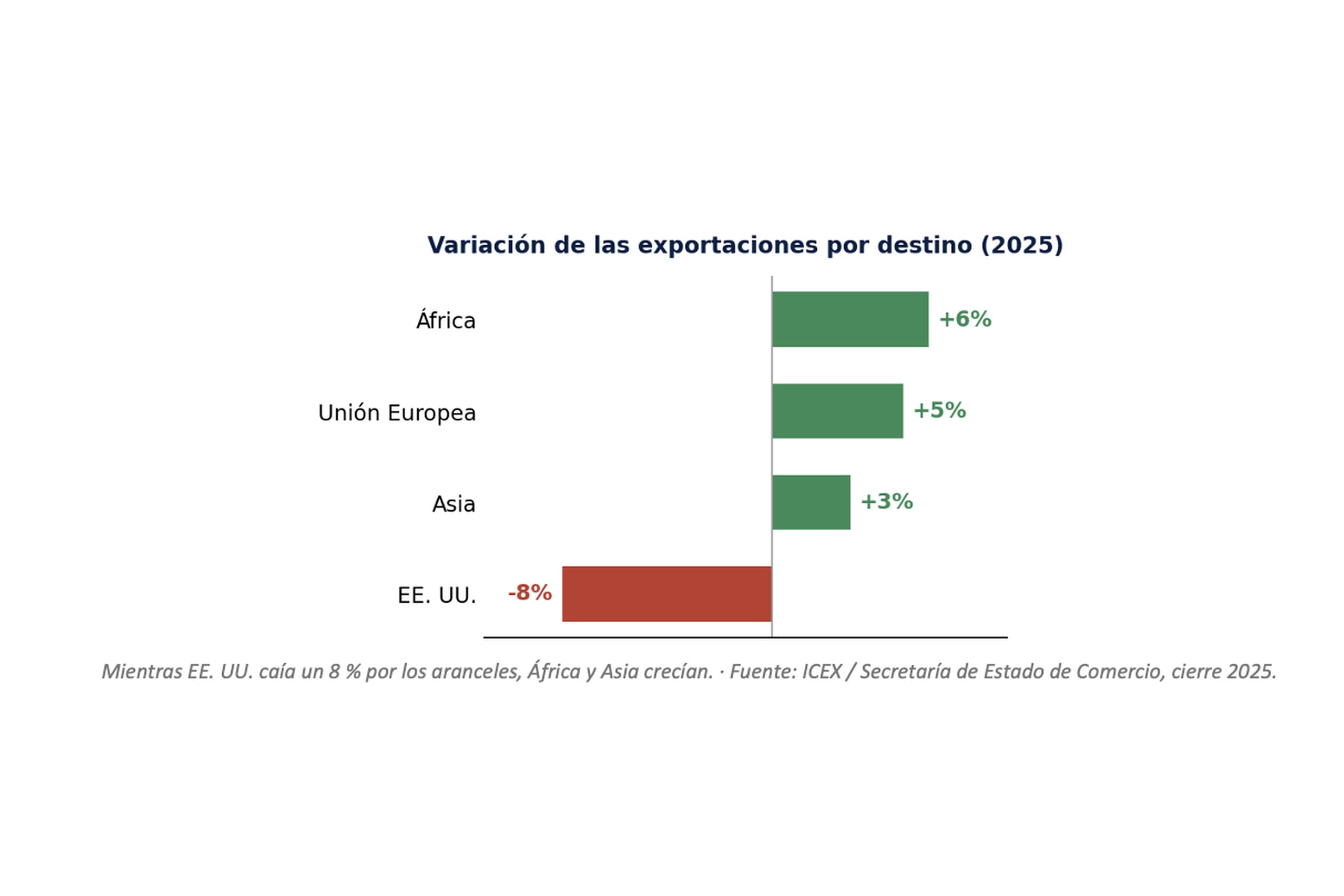
What this means for 2026
Less guesswork, more data
Choosing the right market isn’t about guessing: it’s about scoring. The idea is to rank candidate markets based on those five filters, using real data on consumption, competition, and barriers, and narrow the list down to two or three priority countries rather than a list of ten that you can only serve halfway. Focusing your efforts on the markets with the highest likelihood of generating sales is what turns the intention to export into actual sales.
That’s precisely the approach behind Oftex’s Country Selector, a tool that, based on your product, industry, and positioning, identifies the international markets that are the best fit—and that BBVA customers can use free of charge under the agreement between the two organizations.
There are nearly 200 countries in the world, but your product isn’t a fit for all of them. Choosing the right ones is the difference between exporting and wasting your money.
If you need help selecting markets professionally, BBVA and OFTEX offer a free online tool that makes this easier and also provides an internationalization assessment. All you have to do is register here: oftex.es/bbva-test-exportador-selector-paises/
*This content, prepared in collaboration with Oftex, is provided for informational purposes only. The opinions and assessments reflect the situation as of the date they were prepared and may change without prior notice. It does not constitute advice or a recommendation, nor does it necessarily reflect BBVA’s position.
Internationalization Team — Oftex
Internationalization Consultant · BBVA Partner · oftex.es
Sources: La Moncloa / Secretary of State for Trade (press release, Feb. 19, 2026) · ICEX, 2025 Trade Balance · Oftex Internationalization experience (25+ years, 700+ companies), BBVA partner.